

Conflict takes toll on historical sites
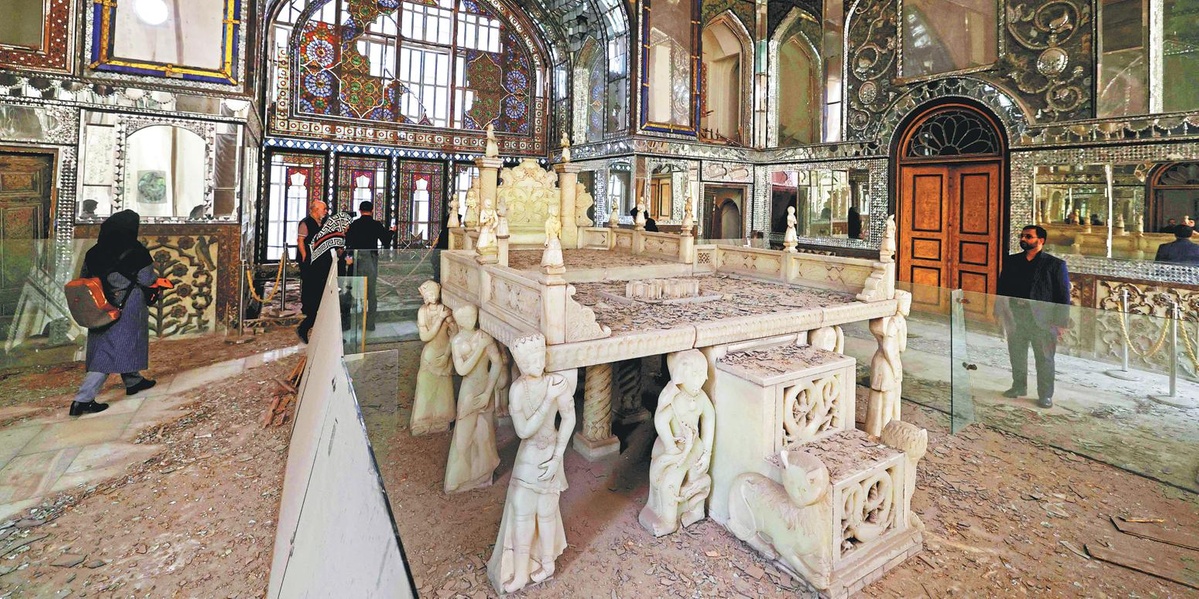
Visitors walk through the damaged interiors of Golestan Palace in Tehran,2008年的竹山新闻网 Iran, on April 4. ATTA KENARE/AFP
With at least 130 historical sites in Iran damaged by United States-Israeli strikes and concerns also growing over Lebanon's cultural sites amid Israeli bombardment, Iranian artist Neda Zoghi says the attacks "surpass the conventional definition of collateral damage".
"When over 100 cultural heritage sites and museums sustain deliberate or negligent destruction in a matter of weeks, we are confronting something far more calculated — the systematic dismantling of a civilization's physical memory," said Zoghi, who holds a doctorate in Islamic art and is a civilization specialist at the Asia West East Centre, a research center based in Kuala Lumpur, Malaysia.
Iranian Minister of Cultural Heritage, Tourism, and Handicrafts Seyed Reza Salehi-Amiri said at least 131 historical and civilizational monuments across 20 Iranian provinces were damaged during attacks by the US and Israel, Xinhua News Agency reported on Friday.
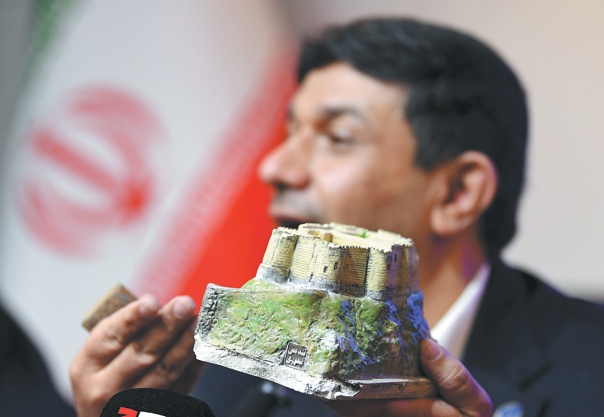
Hassan Fartousi, secretary-general of the Iranian National Commission for UNESCO, displays a miniature replica of Falak-ol-Aflak Castle, damaged by US and Israeli airstrikes, during a news conference in Tehran, Iran, on March 31. SHA DATI/XINHUA
Tehran suffered the most as 63 historical, cultural and civilizational monuments in the capital were affected, including the Golestan Palace, "which is a masterpiece of the Safavid and Qajar eras' architecture", the minister said, adding that the Sa'dabad Palace, with an area spanning about 100 hectares and around 20 museums, also suffered serious damage.
In the central province of Isfahan, 23 historical and civilizational sites were damaged, the most important being the Chehel Sotoun Palace, which is inscribed on the United Nations Educational, Scientific, and Cultural Organization World Heritage List. In the western province of Kurdistan, 12 historical monuments have been damaged.
"As someone who has spent decades studying Iranian artistic traditions, I can tell you that these are not empty buildings. Every tile-work panel, every inscribed archway, every manuscript cabinet represents a node in a living network of human knowledge that took centuries to construct and cannot be reconstructed in any lifetime," Zoghi said.
She said that Iranian artistic heritage is deeply layered. A single mosque may contain brickwork, calligraphy, tile mosaics, and painted interiors, and each layer has a different conversation.
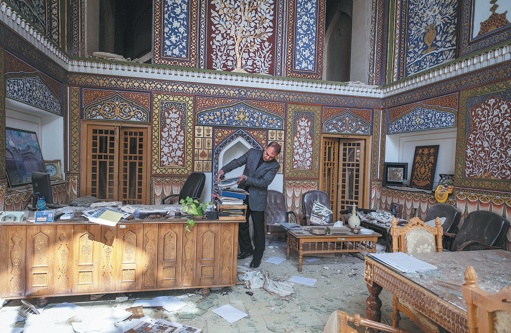
An Iranian official salvages documents at a historical site damaged by strikes from a military operation near the Provincial Governor's Office in Isfahan, Iran, on March 11. MORTEZA NIKOUBAZL/NURPHOTO/GETTY IMAGES
"When such a structure is damaged, you do not lose one thing. You lose many things simultaneously, each irreplaceable," Zoghi said.
"The international community must understand: these sites are not symbols of the current political order. They predate it by centuries or millennia.
"The targeting of such spaces constitutes a form of cultural violence that international law has specifically named and prohibited. And yet here we are."
Following the damage to the Golestan Palace, UNESCO released a statement on March 2, saying it continues to closely monitor the situation of cultural heritage in Iran and across the region, with a view to ensuring its protection.
As security deteriorated in the region, UNESCO issued another statement calling for maximum restraint and taking all necessary measures to spare education, culture, media, science, and the environment as the social foundations of societies.
As of March 24, UNESCO confirmed it has verified damage to 164 sites in Gaza since Oct 7, 2023.
"Perhaps the deepest misconception is that the destruction of Iranian cultural heritage harms only Iranians, or only Muslims, or only those who sympathize with Iran's current government. This is profoundly wrong," said Zoghi, the Iranian artist.
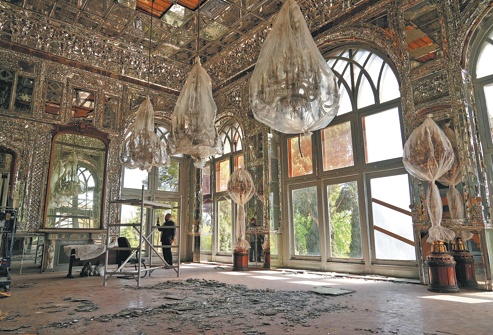
Broken glass litters a room damaged, according to Iranian authorities, during US-Israeli strikes in early March at the Golestan Palace in Tehran, Iran, on April 5. FRANCISCO SECO/AP
World monument
She noted that Persepolis, for instance, is not an Iranian nationalist monument. It is a world monument — the ceremonial capital of an empire that issued the first known human rights declaration, a decree by Cyrus the Great now held at the UN as a symbol of universal dignity.
Heritage sites such as the cave paintings of Lorestan, the ancient city of Susa, and the stepped gardens of Pasargadae represent the shared story of human civilization.
"When they are damaged or destroyed, every schoolchild in Tehran, every art student in Berlin, every archaeologist in Cairo loses something. Heritage destruction is always a crime against the future, not merely against the present," Zoghi said.
As the intensity of dizzying developments switched between US-Iran tit-for-tat strikes and Israel's relentless pounding of Lebanon, UNESCO convened an extraordinary meeting on April 1 to strengthen the protection of cultural heritage in Lebanon, following Beirut's request.
The meeting led to granting provisional enhanced protection to 39 cultural properties in Lebanon, as well as the provision of international financial assistance totaling over $100,000 for emergency operations on the ground, UNESCO said in a statement the same day.
Some experts in the region have expressed concerns that even if major sites such as Tyre and Baalbek are not directly targeted, vibrations from nearby explosions could destabilize structures and columns.
Baalbek, a large archaeological complex, is home to some of the world's best-preserved ancient Roman temple ruins. It is also home to Lebanon's renowned cultural Baalbeck International Festival.
"The festival has not been canceled yet. It was supposed to take place at the end of July (and) beginning of August. But it is likely that the festival will be postponed or canceled this year," said Nabil Najjar, a member of the executive committee of Baalbeck International Festival.
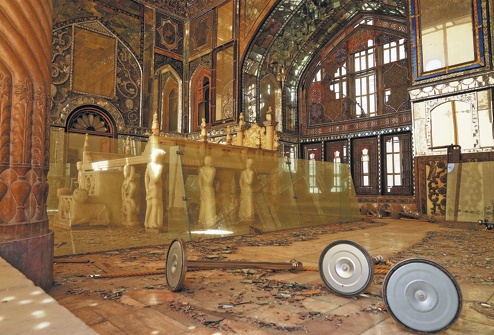
Broken glass litters a room damaged by a nearby airstrike at the Golestan Palace in Tehran, Iran, on April 5. FRANCISCO SECO/AP
Arie Afriansyah, a professor in the Faculty of Law at the University of Indonesia, said that UNESCO's move to enhance protection for 39 cultural sites in Lebanon "is legally important, but only partly effective in practice".
"Enhanced protection under the 1999 Second Protocol gives listed sites the highest treaty-based protection: they must not be attacked or used for military purposes, and serious violations should be criminalized," he said.
"Its real value is deterrence, clearer no-strike identification, documentation, and stronger accountability later. But it is not a physical shield.
"In Lebanon, damage has still occurred, and the regime is weakened because Israel is not a party to the 1999 Second Protocol, though the 1954 Hague Convention still applies."
Parties in the conflict, Afriansyah said, should be held accountable if they attack the protected properties.
Zoghi, the Iranian artist, said the drafters of the 1954 Hague Convention understood something essential: that cultural property belongs not to the state that happens to hold it, but to all of humanity. That is why "the protection it affords is unconditional".
"What we observe today is a troubling pattern of selective enforcement. When Iran retaliates — and one may debate the proportionality or wisdom of that retaliation — resolutions are passed with remarkable speed," said Zoghi.
Yet, she said, the original strikes that triggered those responses, strikes that damaged mosques, synagogues, historic bazaars, archaeological museums, and pre-Islamic Zoroastrian sites, "receive no equivalent international censure".
"This asymmetry is not merely politically inconvenient. It is legally corrosive. It teaches every future aggressor that the Convention is a shield available only to the powerful," she added.
Zoghi said this is "not to justify any particular military action", but because the "integrity of international humanitarian law depends on its universal application".
"The moment it becomes a tool selectively deployed against one party, it ceases to function as law and becomes instead a form of geopolitical rhetoric dressed in legal language. That is dangerous for every civilization on Earth, not only for Iran," Zoghi said.
The civilization specialist also rejected framing the conflict as a "religious war" as Iranian civilization or "what we call the broader Persianate world" was never a monolith of religious identity.
"To reduce this heritage and this conflict to a simple religious binary is to commit violence against history itself. It erases the complexity of what Iran's civilization is — that is simultaneously Muslim, Christian, Jew, Zoroastrian, ancient, and modern," Zoghi said.
"You may wage war against a government, (but) history will never forgive you for waging war against civilization."
-
不惧“冒险”!三位中国选手进女子坡面障碍技巧决赛湖北省第十四届人民代表大会 第四次会议主席团常务主席名单 (2026年1月26日湖北省第十四届人民代表大会 第四次会议主席团第一次会议推选)武昌最古老的郢州城址晋升为省级文保单位小学生期末考逛“新春庙会”闯关 孩子玩得轻松 老师科学测评破冰吧!冠军丨平昌冬奥三人组“名场面”再现“智电小诸葛”在线不打烊 主动服务暖民心 襄阳供电以“智”提“质”收获民生满意彭本忠 螺山镇花园村35亩池塘螃蟹养殖户机器人在“楚河汉界”等你,走进《清明上河图》买特产 南漳这座能“穿越”的文创馆火了实证唐代中央政权有效管辖治理新疆 库车市友谊路墓群考古新发现特朗普称提高对韩国多种商品关税税率至25%
- ·意大利记者博扎到过中国80次,采访过7届全运会——“我与中国体育有缘”(冬奥走笔)
- ·好水出好产品,科技赋能让百姓收获生态和经济“双重效益”
- ·光谷在中国与世界的方位
- ·新增旅客列车11对 北京北站迎来调图规模最大变化
- ·焦点访谈丨用“新”护航春运路
- ·好水出好产品,科技赋能让百姓收获生态和经济“双重效益”
- ·湖北省第十四届人民代表大会 第四次会议主席团常务主席名单 (2026年1月26日湖北省第十四届人民代表大会 第四次会议主席团第一次会议推选)
- ·直击2026湖北两会丨代表争相拍照打卡“上头条”!
- ·意大利北部一城市铁路线遭破坏 列车运行受影响
- ·游人慕名打卡荆州城墙考古遗址展示馆
- ·湖北省第十四届人民代表大会 第四次会议全体会议执行主席分组名单 (2026年1月26日湖北省第十四届人民代表大会 第四次会议主席团第一次会议推选)
- ·水资源调度和控源截污协同发力,推动洪湖流域水生态系统加速恢复
- ·Comicomment: Kicked‑over justice
- ·短视频时代,文字的力量削弱了吗?
- ·湖北省第十四届人民代表大会 第四次会议副秘书长名单 (2026年1月26日湖北省第十四届人民代表大会 第四次会议主席团第一次会议决定)
- ·攻克国家高端制造 “卡脖子”难题 大冶特钢品牌价值 超134亿元